
Hangry /han-gree/ – (adj.) being highly irritable due to hunger.
Traditionally, eating habits were very predictable. You grab a quick bite in the morning, have a second meal during lunch and head back for a home-cooked dinner with the family, right? Well, times are changing, and eating trends have not been excluded from the mix. The fact of the matter is, most of us today live fast-paced lives, and it’s not uncommon that we get so engulfed in work that mealtimes get pushed indefinitely. Before we know it, the sun’s down and our hunger-induced irritation takes over – we find ourselves downright hangry.
What now? It’s incredibly hard to focus when your irritation comes from hunger. With time constraints cooking comes a hard no, and so is eating out. Do you know what’s convenient? Online food delivery.
There is no denying that lifestyle changes have been the primary driving force behind the success and rapid growth of the food delivery industry. According to a report by Mordor Intelligence, millennials are quickly changing the trends we previously have associated with meals due to a couple of reasons. Firstly, the act of eating out or ordering in is normalized today due to its convenience, as compared to the past expectation of families having to prepare their own home-cooked meals. Thus, although food delivery is not a new concept, many new online platforms have emerged with new, cutting-edge technology to cater to the apparent lifestyle changes and fill the gap in the food delivery market. From what used to be your single neighbourhood eatery sending food to local residences, you now get online apps providing city-wide food deliveries of a multitude of different cuisines, restaurants, and food options – some even accessible 24-hours a day. (You read correctly, you no longer have to sleep through your 3 am cravings!) With convenience placed at the top priority of our time-starved culture, it is no wonder why millennials are said to be three times more likely to use online delivery services that the older generational blocks! (source)
Figure 1: Users of Online Food Delivery Apps by Age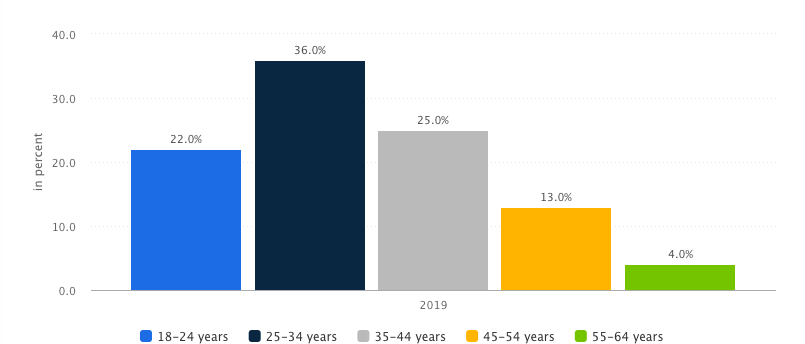
Source: Statista Global Consumer Survey, October 2019.
The future of the online food delivery market is also attractive. The current global size of the online food delivery market is estimated to be USD160 billion and expected to exceed USD200 billion in terms of gross revenue bookings by 2025, as many sources anticipate double-digit CGRs between 11 to 14 percent (source). Apart from convenience, there is also another emerging trend that contributes to this success. In a survey by AHA News, millennials are also demanding healthier and sustainable options when it comes to food. This is reflected in their spending patterns, with reports claiming that millennials at large allocating a bigger portion of income to purchase organic foods and ensuring their food sources are produced in sustainable ways.
With the need for sustainable consumption on the rise, how does the food delivery industry measure up? At a glance, not so well. Most food delivery riders in Southeast Asia depend on gasoline-powered motorcycles due to their handy and timely nature. However, having less sophisticated fuel systems and emission controls than cars, gasoline-powered motorcycles are notorious for their harmful emissions of harmful pollutants such as carbon monoxide, hydrocarbons, and nitrogen oxides. When depended on so largely by the food delivery industry, the need for sustainability begs a different option, especially for those who are environmentally conscious. With the anticipated continued growth of the food delivery industry and environmental concerns on the rise, emerges the new online food delivery app, GoApe.
GoApe joins the market of online food delivery with the aim to provide the most satisfying delivery experience to their customers, all whilst giving them ease of mind from the worries of environmental concerns. Having an emphasis on their riders to operate on electric bikes, GoApe meets its environmental responsibility by ensuring lesser emissions of pollutants are made during its operations, whilst still serving their customers affordable, fast, and quality assured deliveries. The usage of electric bikes also allows them a lower OPEX as compared to its competitors that depend solely on gasoline-powered motorbikes for transportation.
Aiming to raise RM2mil on Ata Plus’ ECF platform in return for 9.09 percent of equity, GoApe plans to channel the funds into developing the technology of their mobile app, marketing and assisting their working capital.
The need for ensuring sustainability across all industries is a responsibility of all. While many trends come and go, we must understand that environmental concerns stretch beyond just being a fad in our generation, and would actually worsen should we not play our role and take correct measures to correct it. With this, show support to GoApe by giving them the opportunity to be the most preferred Green Online Food Delivery Platform in Malaysia and beyond.